At our arts and crafts group last week I took along a length of rod to shape into the vacuum pipe that runs the length of the valance on the right hand side of the loco (a similar air pipe runs along the left hand valance). I only took the one length expecting it to take some time. As it happens I had it bent into shape in about five minutes so sepen the rest of the session talking to a friend.
Next on my list was balance pipes which fit behind the rear steps.
These were made to the dimensions of the GA and finished with some turned disks to represent the flanges.
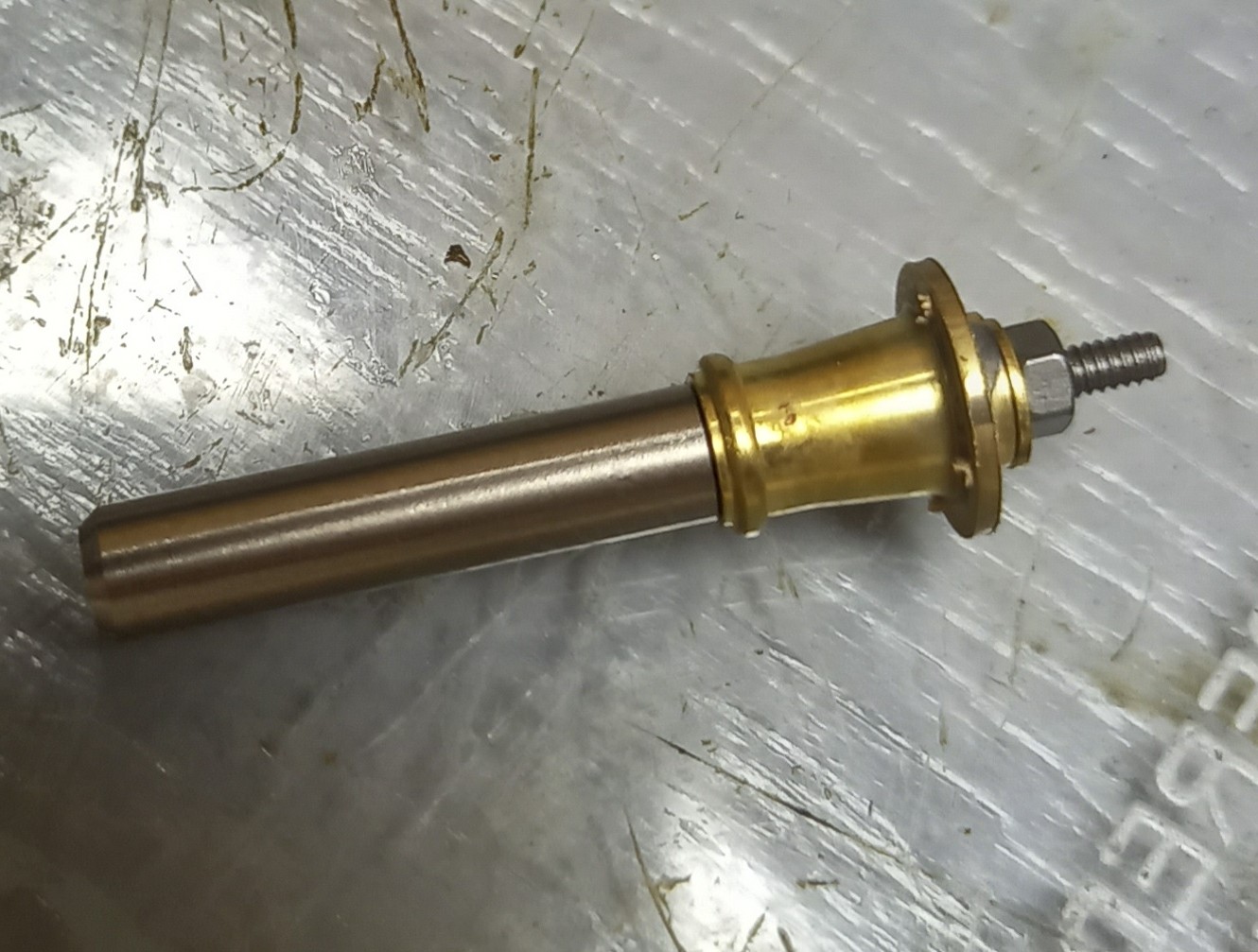
Next up was drilling out and fitting simulated bolt head to the buffer stocks. Due to the taper of the buffer stocks I figured it would be difficult to hold them securely without marking them and after some though I came up with an idea for a jig. The jig is made from 4mm steel bar recovered from a scrap printer, turned down to be a close fit in the major hole in the buffer stock and then threaded 10ba at the end.
This allowed the buffer stocks to be held upside down in my Proxxon dividing head to allow the drilling of holes for the simulated bolts.
There isn’t a lot of room for the bolt heads on the flanges of the buffer stocks so I needed something quite small. O opted to file som hex heads on some brass dressmakers pins but found that the smallest collet for my hex pin vice wouldn’t tighten down small enough to grip the pin shanks.
I’m not sure where it came from but in my tools I have a very small pin chuck which I believe is designed to hold very small drills in a bigger chuck on the lathe
After digging it out and pondering how I might index it I wondered if the thread was metric and by good fortune the very first nut that I tried fit perfectly (M5) this meant that I was able to tighten the pin chuck to grip the shank and then tighten the nut against the back of the collar to allow each facet to be indexed
After soldering the simulated nuts in place. I was able to use the little jig again to hold the buffer stock while I cleaned up the back of the protruding pins up in the lathe.